
Warehouses and logistics centers
High racks, cold storage areas, loading docks, underground zones, and deep aisles create typical dead zones.
Reduce radio dead zones in warehouses, tunnels, basements and changing job sites.
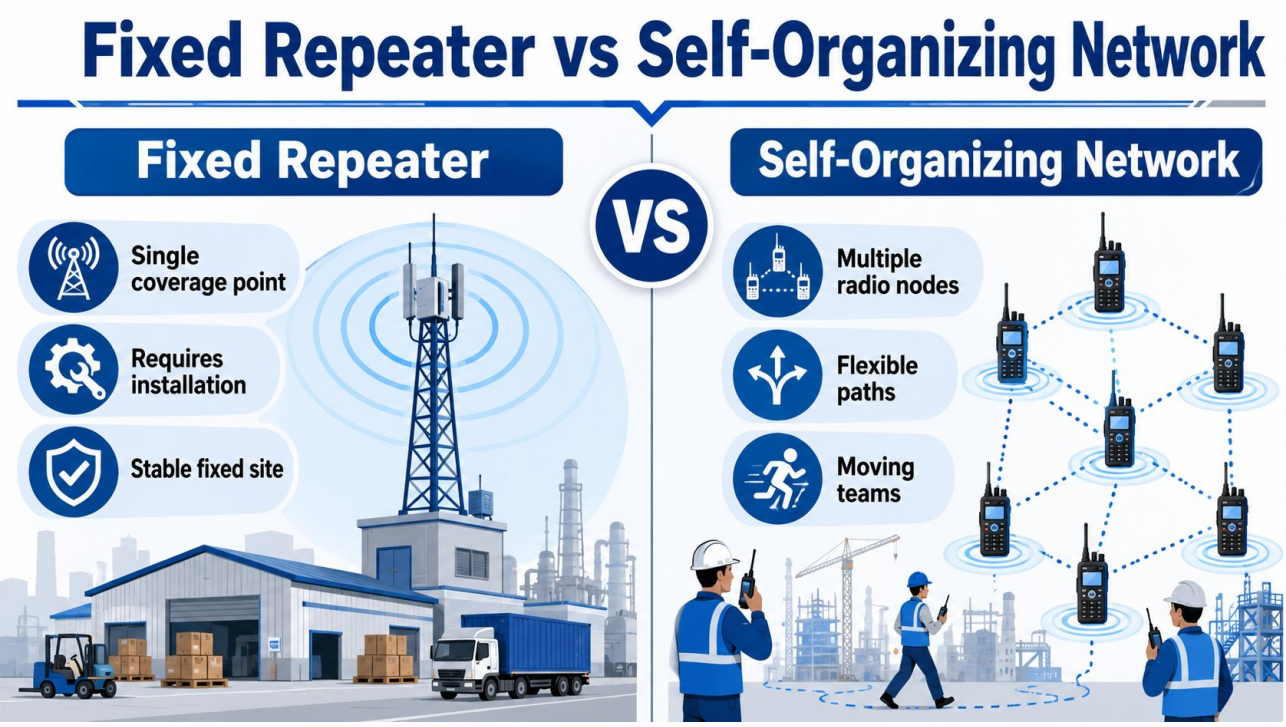
30-hop mesh relay means a digital radio signal can be forwarded hop by hop through multiple nearby radios, instead of relying only on one direct link. It does not make one radio 30 times more powerful. It allows the team's radios to work together across sites where walls, distance or underground structures block direct communication.
On a real job site, a missed radio call is often more than an inconvenience. A forklift driver misses a stop instruction, a tunnel crew cannot reach the surface team, or a security guard suddenly loses contact in a basement. These are safety and downtime issues, not just signal-bar issues.
The point most buyers misunderstand is this: when a radio works well outdoors but fails inside a building, the problem is usually the signal path, not simply the radio power.
Concrete walls, metal racks, underground floors, tunnel curves, steel structures, cold storage areas, and site layouts that change every week can all block or weaken radio signals. This is the problem that 30-hop mesh relay is designed to solve.
Instead of forcing Radio A to reach Radio F directly, the signal passes through radios in between. Communication no longer depends on one direct path. The radios already on site become part of the transmission path.
Traditional radio communication relies on a direct wireless path: Radio A talks directly to Radio B. When the path is clear, communication is usually stable. But industrial sites are rarely that simple.
Common signal-blocking conditions include:
The approach of mesh relay is to give the signal another path. The signal does not need to force its way through the obstacle. It can be forwarded hop by hop through radios placed in better positions and then continue toward the target area. In plain terms: it goes around the problem instead of crashing into it.
Each digital radio can be understood as a "communication point." When multiple radios are powered on, correctly configured, and operating in the same local network, they can automatically form a transmission path based on their positions and link quality.
For example, Radio A needs to reach Radio F, but the distance is too long or a wall blocks the signal. As long as A can reach B, B can reach C, and C can reach D, the signal can keep moving forward. This is the basic principle of multi-hop forwarding.
The "30-hop" capability means the system can support deep, multi-level forwarding under suitable conditions. The final result always depends on the real site: radio quantity, spacing, layout, wall and floor structure, tunnel shape and depth, rack density, and the local frequency environment.
A traditional repeater is usually installed at a higher fixed position. It receives the signal and retransmits it to expand coverage. For stable, long-term sites such as factories, hotels, and industrial parks, a fixed repeater is still a suitable choice.
But fixed repeaters also have limitations: they require installation, power, and antenna planning; the location must be chosen carefully; temporary projects often do not have time for fixed installation; and if the repeater fails, a whole coverage area may be affected.
Mesh relay radios use a more flexible logic. Each radio can talk and also forward signals, so any properly placed radio can become one more forwarding point. This does not mean fixed repeaters are no longer useful. In many projects, fixed repeaters, relay radios, gateways, and dispatch platforms work together.
Mesh relay is most valuable in real-world environments with obstacles, moving teams, changing structures, and weak public networks.
High racks, cold storage areas, loading docks, underground zones, and deep aisles create typical dead zones.
Long-depth structures, curves, rock layers, reinforced concrete, and weak public networks make these sites difficult.
Today's open floor may become a concrete wall or basement next week. Radio positions can adjust as the work changes.
When public networks are down or congested, relay-capable radios can quickly build on-site voice communication.
| Scenario | Communication Challenge | Practical Value |
|---|---|---|
| High-density warehouse | Metal racks, cold storage walls, loading areas | Reduce local dead zones, improve dispatch |
| Tunnel / pipe gallery | Long depth, weak public network, curved structure | Extend signal hop by hop along work route |
| Basement / underground parking | Concrete blocks signals between floors | Connect surface teams with underground teams |
| Construction site | Structures and layouts keep changing | Mobile radios adjust the path as conditions change |
| Emergency response | Weak public network, temporary deployment | Quickly build a local communication link |
Setting expectations early helps avoid a poor deployment later.
30-hop mesh relay is a core capability of B15 and B15P: local networking, built-in relay, and multi-hop forwarding. Best suited for tunnels, underground spaces, large warehouses, cold storage sites, mines, construction sites, and industrial parks.
Choose B15P when screen display, channel information, and more detailed operation control are needed. For a small or simple warehouse with stable coverage, B17 may be sufficient.
The clearer the site information, the easier the solution is to evaluate. If possible, prepare the following: